
Insight
Insight
July 9, 2026
The following article was written and published in Banker & Tradesman on June 28, 2026. Read the article below or in Banker & Tradesman here.
Boston has a housing shortage, and the answer does not always have to begin with a vacant lot or a full demolition. Adaptive reuse projects remain a strong solution to revitalize underutilized buildings for residential, commercial or civic use. Converting vacant or underutilized structures into residential units enables cities to add housing while preserving neighborhood character and reducing environmental impacts.
According to the 2022 Boston Housing Conditions and Real Estate Trends Report, more than 20,000 units were added to Boston’s inventory between 2017 and 2021; Greater Boston added more than 71,000 units from April 2020 to July 2025, according to the 2025 Greater Boston Housing Report Card. Yet the ongoing housing shortage demonstrates the need for additional strategies beyond new construction.
The city of Boston owns 9.5 million square feet of vacant or underutilized land, according to the 2022 City Land Audit. While the city does not have an official count of privately owned vacant land, it would be no surprise if there is an abundance of underutilized space that could be used for housing. Adaptive reuse provides an opportunity to transform some of these spaces into housing while preserving existing neighborhood character.
Among the successful examples of adapting existing buildings for housing in Boston are developments that have transformed vacant churches.
Church-to-Condos Includes Expansion in South End
One successful example is The Lucas at 136 Shawmut Ave in the South End. In 2017, Boston-based Finegold Alexander Architects converted the 1874 German Trinity Catholic Church into a luxury condominium development. The interior construction and roof were removed and the historic façade stabilized. Thirty-three residential units were created across eight new floors both within the Gothic shell and in a new vertical addition. The design of the contemporary infill both responded directly to the historic exterior and added practical use to the site.
A similar approach has been taken at Finegold Alexander’s ongoing La Victoire development at 25 Isabella St. in the Bay Village neighborhood. The project transformed the former 1891 Our Lady of Victories Church into 18 units – 16 of which are luxury condominiums, with two affordable units. The historic masonry exterior was preserved and the original windows replicated. The vertical addition is set back from the street, maintaining the scale and presence of the façade along the street. Through removal of the interior structure and a defunct parish house and constructing a new 7- story infill and addition, the project adds to the city’s housing stock while preserving the historic fabric of the neighborhood.
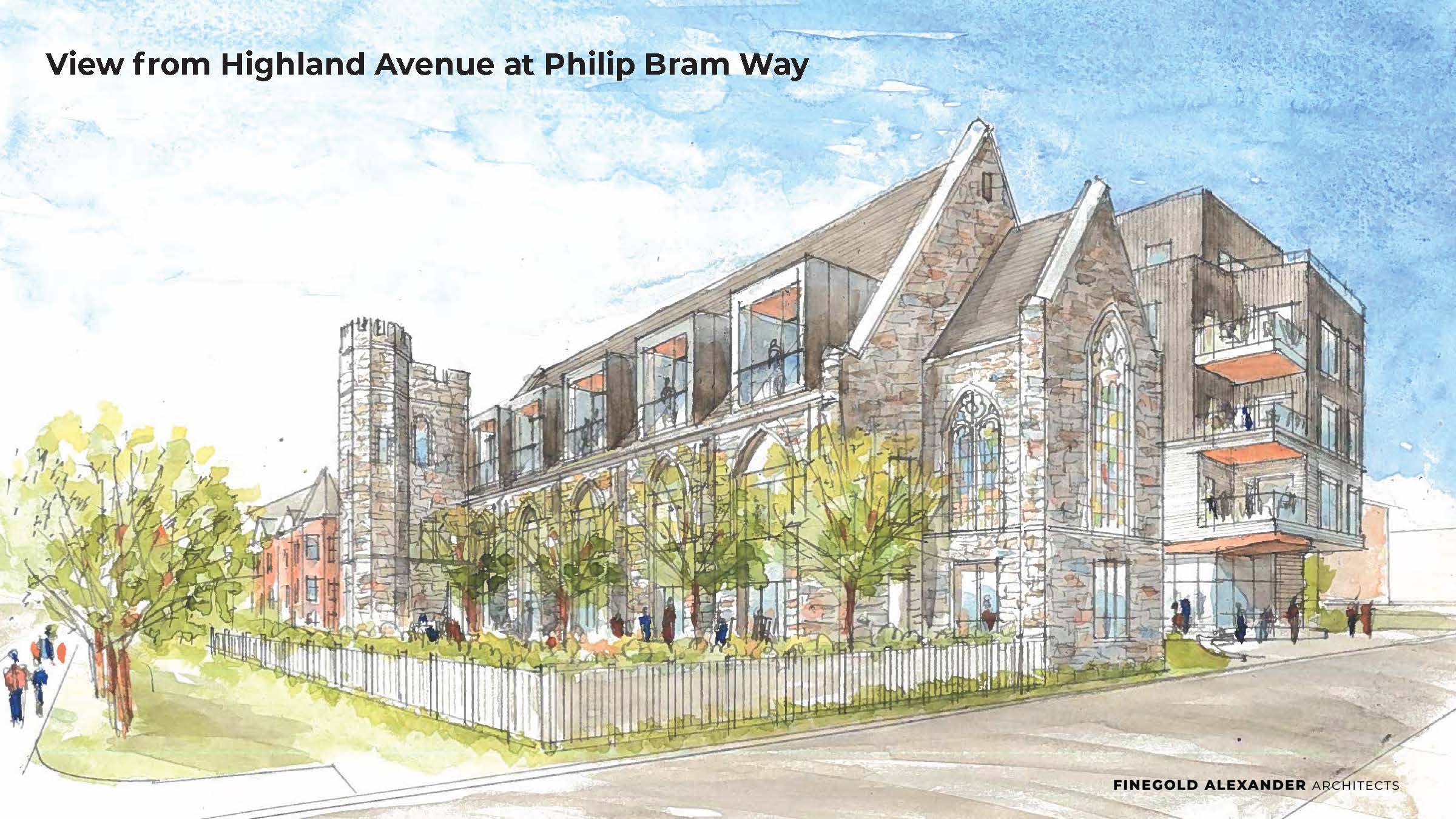
Outside of Boston, the newly approved development at 19 Highland Ave. in Newton will transform an unused church into six residential units. The Gothic Revival-style vacated former Swedenborg church was at risk of being demolished as it was underused in a thriving commercial location.
Following a landmark designation by the local Historic Commission, however, Finegold Alexander was retained to design units that would preserve the church’s historic details. One important detail is six major windows designed by famous painter and stained-glass artisan Charles Jay Connick. From the street, the 19 Highland Ave. development will appear largely the same, without the setback infills of The Lucas and La Victoire, while the larger project includes an adjacent new construction development on the site, increasing the number of housing units.
Across these projects, adaptive reuse and sustainability are closely linked. Preserving major masonry walls and, in some cases, existing structure, these conversions reduce embodied carbon compared to new construction. Energy retrofits to the existing shells and upgraded building systems will enable the renovated structures to provide for low energy use units, also reducing operational carbon use.
In Boston and the surrounding area, adaptive reuse projects can take advantage of significant underutilized buildings, addressing the housing crisis, both in affordable and high-end markets. Adapting and repurposing historic buildings retains neighborhood character and preserves our collective history for decades to come.
You may also like this
